Dujiangyan: The 2,000-Year-Old Dam That Isn’t a Dam
Dujiangyan: The 2,000-Year-Old Dam That Isn't a Dam
There is a machine in western China that has been running for more than 2,000 years. It has no engine. It has no moving parts. And here is the strange part: it has no dam. It is the oldest and only surviving no-dam irrigation system in the world, and it still works — still watering the fields around Chengdu, a city of more than twenty million people (20.9 million at the 2020 census), as it did when Rome was a young republic.
It was built with bamboo, stone, fire and river water, and it is still maintained by rules written down in six Chinese characters. This is Dujiangyan — the dam that isn't one.
A River of Flood and Drought
The Min River is born high in the mountains of Sichuan. For most of its journey it is squeezed between steep rock walls, fast and cold. Then the walls end. The river bursts out of the mountains and spreads across a huge, flat bowl of land: the Chengdu Plain.
Flat land, rich soil, a long growing season — it should have been paradise. Instead, it was a trap. In summer, mountain rain and meltwater arrived together, the river slowed and rose, and it drowned the fields. In winter, the same river shrank — and the plain went thirsty. Flood or drought. Feast or famine.
Everyone knew the obvious answer: build a dam. It is the answer Egypt and Mesopotamia chose. In China, in the third century BC, one man looked at this river and chose something else entirely.
The Governor Who Wouldn't Build a Dam
His name was Li Bing. Around 256 BC, the state of Qin appointed him governor of Shu — the region we now call Sichuan. Qin had conquered Shu some sixty years earlier, in 316 BC, and wanted this plain to become a granary for its armies. A plain that flooded one year and starved the next was useless for that. Li Bing was sent to fix the river.
According to the old accounts, he did something unusual for an official: he went and looked. He travelled the river, studied where the water ran fast and where it ran slow, where the sand settled and where it scoured. And he reached a conclusion that sounds almost modern: the river was not the enemy. It was energy looking for a path. Don't block it. Divide it. Guide it. Let the water tame itself.
He built the system with his son and thousands of local workers. There would be no wall across the river — instead, three inventions, working as one machine.
Meanwhile, Around the World
To feel how long ago this was, look at what the rest of the world looked like in 256 BC.
Alexander the Great had been dead for less than seventy years, and his generals' kingdoms were still fighting over his empire. On the other side of Asia, the Roman Republic was locked in the First Punic War — a twenty-three-year struggle with Carthage for the island of Sicily. Rome, a land power that had barely had a navy, was learning to fight at sea. When that war ended in 241 BC, Sicily became Rome's first overseas province.
So picture the moment. Two powers were fighting over one island. In China, an engineer was quietly rearranging a river — and his machine would still be running when Rome rose, when Rome fell, and for fifteen centuries after that.
The Fish Mouth: A Levee That Thinks
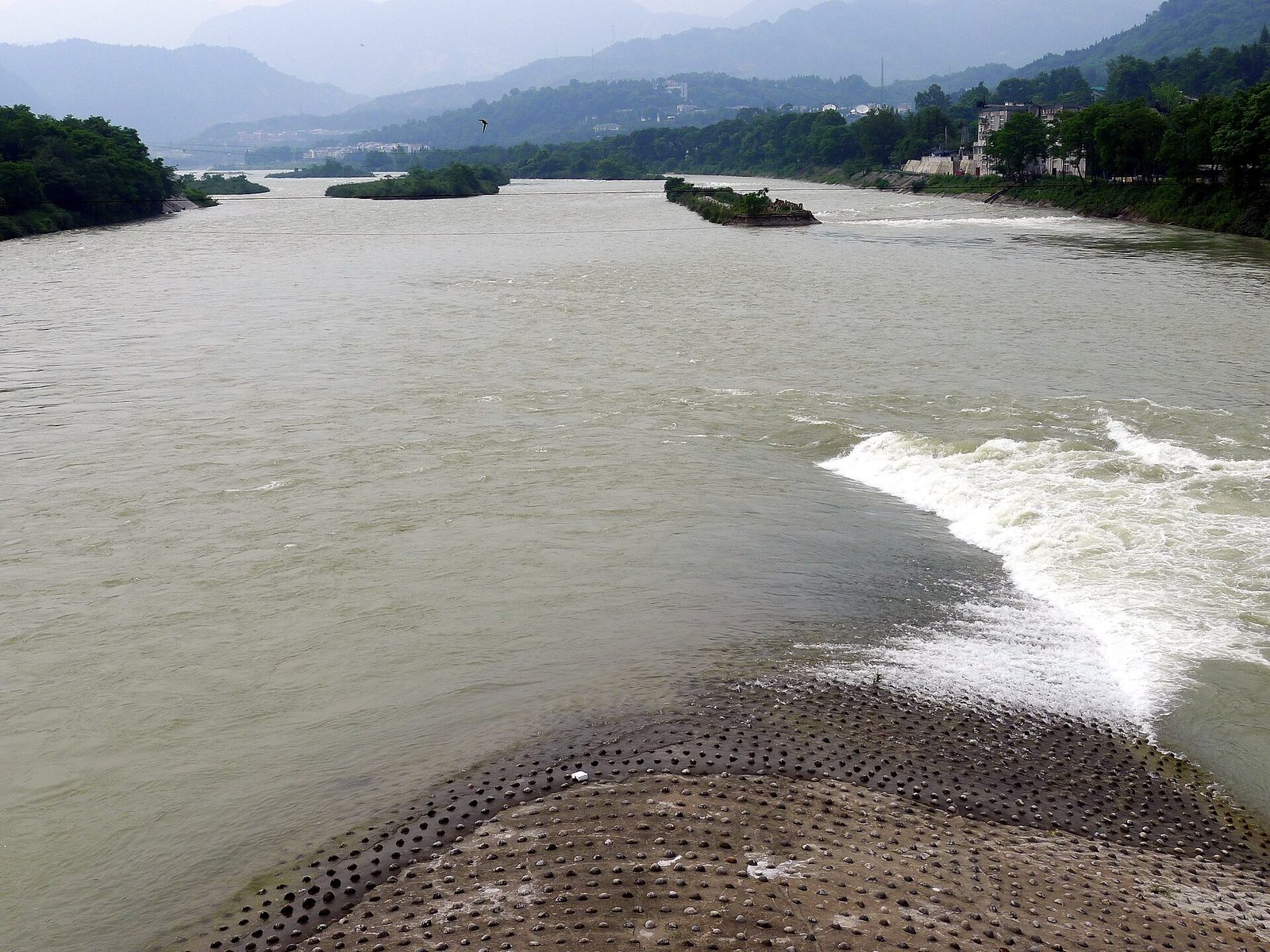
The first invention sits in the middle of the river: a long levee, built originally from bamboo cages filled with stones, its front end pointed like the mouth of a fish. Its Chinese name is Yuzui — the Fish Mouth.
The Fish Mouth splits the Min River into two. The outer river follows the old riverbed, carrying floodwater and sediment away. The inner river is a dug channel heading for the plain — for irrigation.
Here is the genius: the split is not fixed. It changes with the seasons, by itself. The Fish Mouth stands at a bend, and the bend does the thinking. In the dry season, when the river runs low and slow, about six parts in ten of the water flow into the inner channel — just when spring planting needs it most. In flood season, the fast water swings wide around the bend and the ratio flips: about six parts in ten rush down the outer river instead. No gates. No one turning a wheel. The shape of the river decides.
The bend solves a second problem: sand. Silt is what kills irrigation systems — it fills channels until they choke. But in a bend, the heavy, sand-loaded water near the riverbed is flung toward the outer side. By the traditional reckoning — the "two-eight" rule — about eight parts in ten of the sediment are swept down the outer river. The water entering the inner channel arrives comparatively clean.
The Flying Sand Weir: A Safety Valve
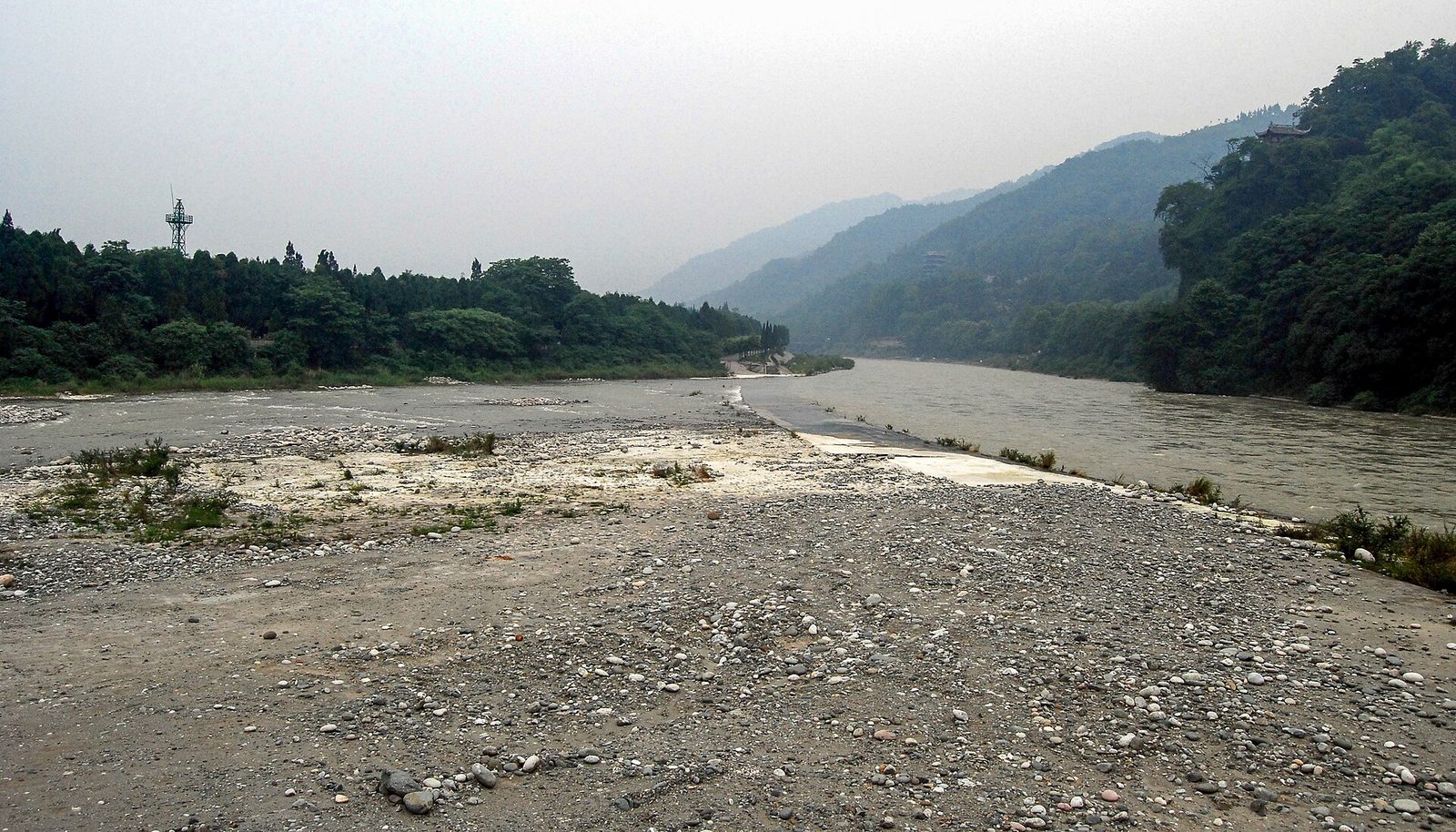
Some sand still gets in, and in a great flood the inner channel could take too much water. So Li Bing's system has a safety valve: a low spillway called Feishayan — the Flying Sand Weir.
Its whole secret is that it is low. When the inner river runs at a safe level, the water flows past it. When the level rises too high, the excess spills over the weir and back into the outer river. And because the channel curves here, the spinning current throws sand and even rolling pebbles up and over with the spilling water — the sand appears to fly. That is where the name comes from.
Keep this weir low, and the plain can never be flooded by its own irrigation channel. Raise it too high, and the safety valve becomes a wall.
The Bottle Neck: A Slot Cut Through Rock
The last invention is the hardest to build, and the simplest to understand. Between the inner river and the Chengdu Plain stood a ridge of solid rock — Mount Yulei. The water could not reach the fields unless it went through the mountain.
So Li Bing's workers cut through it. The old accounts say they used fire and water: heating the rock face with burning wood, then dashing it with cold river water, so the stone cracked, layer by layer. The opening they left is about 20 metres wide, and its shape — narrow, with flared walls — reminded people of the mouth of a bottle. Baopingkou: the Bottle Neck.
The Bottle Neck is the system's final governor. However big the flood upstream, only so much water can physically pass through a twenty-metre slot in solid rock. Everything beyond that backs up, spills over the Flying Sand Weir, and leaves down the outer river. Beyond the mountain, the admitted water divides into canals that spread across the plain by gravity alone — the plain tilts gently from northwest to southeast, and the water simply flows downhill to the fields.
Three inventions. A mouth that divides. A weir that breathes. A neck that rations. Together, they turned a violent river into a managed one — without ever stopping it.
The Six-Character Rulebook
A machine like this has one weakness: silt never stops coming. Leave Dujiangyan alone for a decade and the channels would slowly fill, the ratios would drift, the magic would die. So the fourth invention is not made of stone. It is a habit.
Every year, in the dry season, the system gets its annual repair — in Chinese, suixiu. Crews dam off the channels, drain them, and dig the silt out by hand, as their predecessors have done for over two thousand years. And they dig to a standard: iron bars — the wotie, the "lying iron" — buried in the riverbed by engineers of later dynasties. Dig down until you reach the iron: that deep, no more, no less.
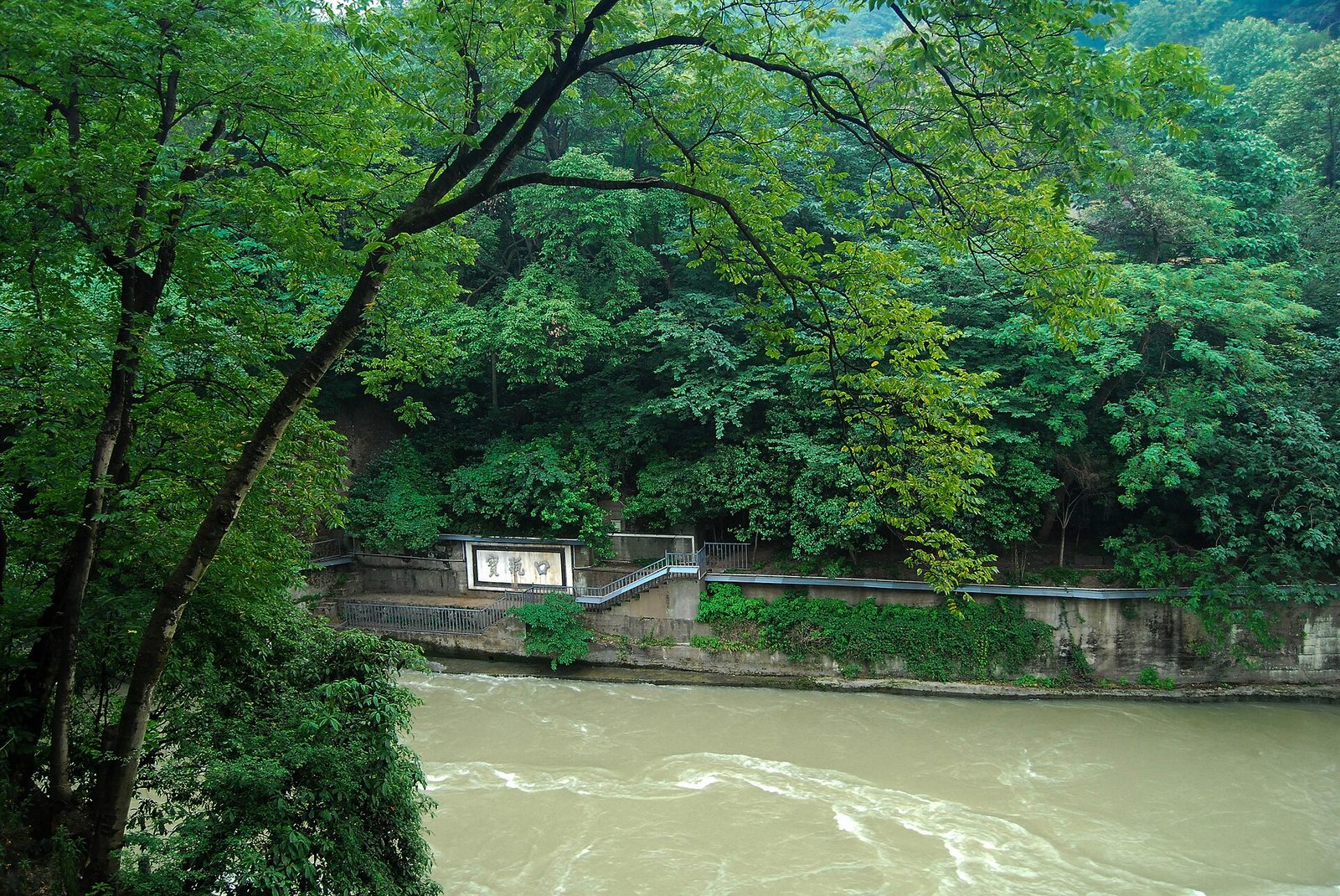
The whole philosophy is compressed into six characters, carved on the stone walls of the Two Kings Temple above the river and repeated by every generation since: Shen tao tan, di zuo yan — "Dig the bed deep. Keep the weir low." Tradition credits them to Li Bing himself. Whether or not he wrote them, they have been followed for more than two millennia.
Still Running
Dynasties rose and fell around this machine, and each one enlarged it. The network grew under the Tang, the Song, the Yuan and the Ming, and the plain it watered became famous across China as the Land of Abundance. In the year 2000, UNESCO placed Dujiangyan on the World Heritage List, together with nearby Mount Qingcheng. And in 2008, when a massive earthquake devastated this part of Sichuan, UNESCO's assessors noted that the irrigation system itself was basically undamaged.
Today, UNESCO counts about 668,700 hectares of farmland irrigated by this system — as far as anyone knows, the oldest large irrigation system in the world that never stopped. Rome's aqueducts are ruins you buy a ticket to look at. Dujiangyan never became a ruin, because nobody ever stopped maintaining it.
FAQ
When was Dujiangyan built, and by whom?
It was begun around 256 BC by Li Bing, the Qin-appointed governor of Shu, working with his son and thousands of local workers, and was essentially complete by about 251 BC.
How does Dujiangyan work without a dam?
Three structures divide and regulate the Min River instead of blocking it: the Fish Mouth splits the flow seasonally (roughly six-tenths inward in the dry season, six-tenths outward in flood), the low Flying Sand Weir spills excess water and sediment back to the outer river, and the Bottle Neck — a gap about 20 metres wide cut through rock — limits how much water can enter the plain.
What is the "two-eight" rule at Dujiangyan?
By the traditional reckoning, the bend at the Fish Mouth flings the heavy, sediment-laden water toward the outer river, so roughly eight parts in ten of the silt are carried away downstream while only about two parts enter the irrigation channel.
What do the six characters "Shen tao tan, di zuo yan" mean?
They mean "Dig the bed deep, keep the weir low" — the maintenance rule for the annual dredging of the channels and the height of the Flying Sand Weir. Tradition credits the rule to Li Bing.
How much land does Dujiangyan irrigate today?
UNESCO counts about 668,700 hectares of farmland irrigated by the system. Dujiangyan was inscribed as a UNESCO World Heritage site in 2000, together with Mount Qingcheng.